
Jake Hagopian, Transformations, Winter, 2004
Description
Journal article, "TimeCapsule," highlighting WPI 1939 alumnus Jacob "Jake" Hagopian's work on hard disk drive innovations while working for IBM. Article appears in WPI Transformations : a journal of people and change, Volume 103, Issue 4, Winter 2004.Date
2004
Coverage
San Jose (Calif.)
Subject
Armenian Americans
Armenian diaspora
Computer science
Engineers
International Business Machines Corporation
Armenian diaspora
Computer science
Engineers
International Business Machines Corporation
Format
magazine clippings
Publisher
Armenians of Whitinsville
Rights
All materials are under copyright by Armenians of Whitinsville.
Type
text
Identifier
aw15_05
Text
Time Capsule
Every time you access your computer's hard drive, you're tapping into the innovative work of Jake Hagopian '39.
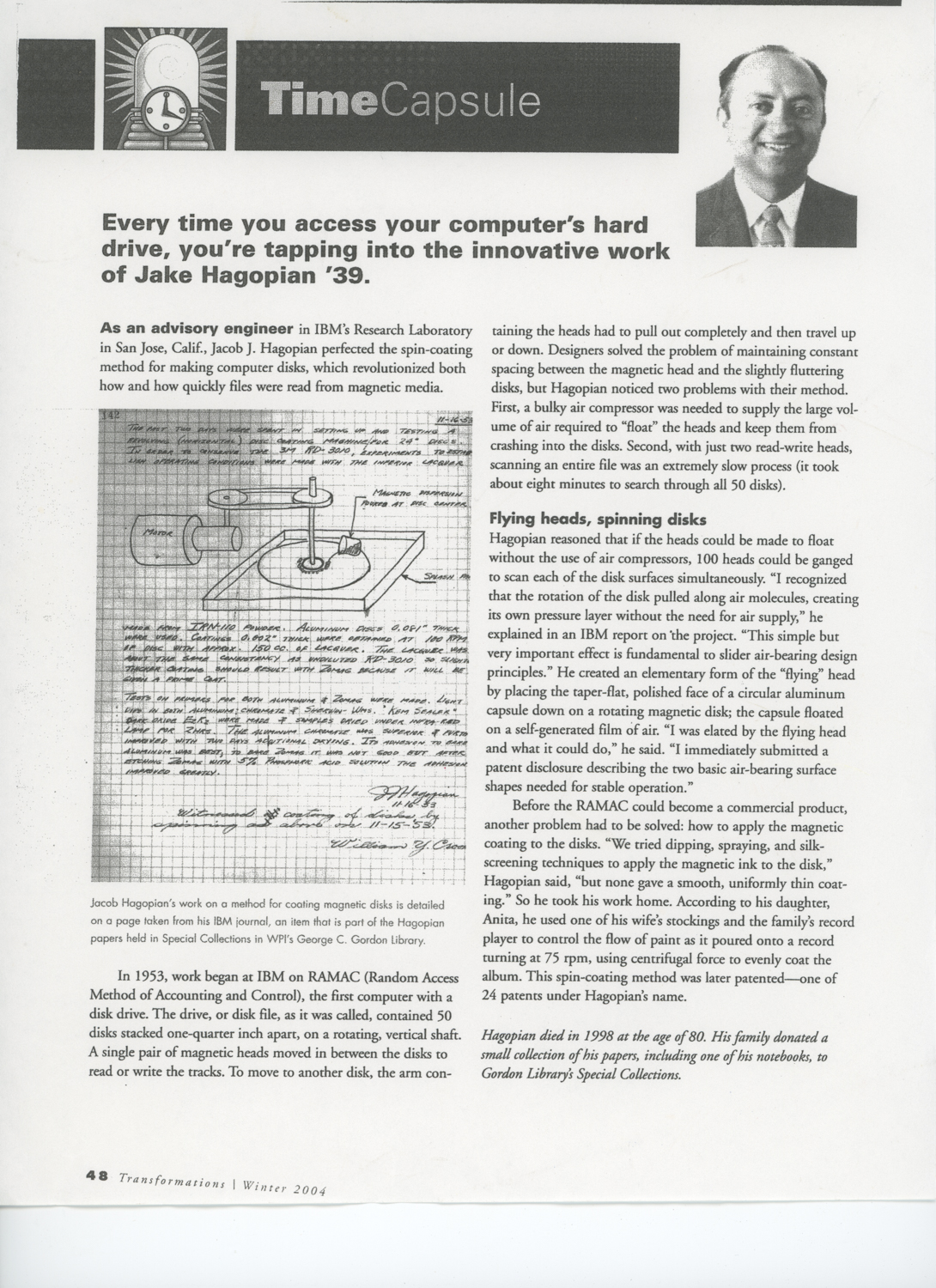
As an advisory engineer in IBM's Research Laboratory in San Jose, Calif., Jacob J. Hagopian perfected the spin-coating method for making computer disks, which revolutionized both how and how quickly files were read from magnetic media.
Jacob Hagopian's work on on a method for coaling magnetic disks is detailed on a page taken from his IBM journal, an item that is part of the Hagopian papers held in Special Collections in WPI's George C. Gordon Library.
In 1953, work began at IBM on RAMAC (Random Access Method of Accounting and Control), the first computer with a disk drive. The drive, or disk file, as it was called, contained SO disks stacked one-quarter inch apart, on a rotating, vertical shaft. A single pair of magnetic heads moved in between the disks to read or write the tracks. To move to another disk, the arm contraining the heads had to pull out completely and then travel up or down. Designers solved the problem of maintaining constant spacing between the magnetic head and the slightly fluttering
disks, but Hagopian noticed two problems with their method. First, a bulky air compressor was needed to supply the large volume of air required to "float" the heads and keep them from crashing into the disks. Second, with just two read-write heads, scanning an entire file was an extremely slow process (it took about eight minutes to search through all 50 disks).
Flying heads, spinning disks
Hagopian reasoned that if the heads could be made to float
without the use of air compressors, 100 heads could be ganged
to scan each of the disk surfaces simultaneously. "I recognized
that the rotation of the disk pulled along air molecules, creating
its own pressure layer without the need for air supply," he
explained in an IBM report on the project. "This simple but
very important effect is fundamental to slider air-bearing design
principles." He created an elementary form of the "flying" head
by placing the taper-flat, polished face of a circular aluminum
capsule down on a rotating magnetic disk; the capsule floated
on a self-generated film of air. "I was elated by the flying head
and what it could do," he said. "I immediately submitted a
patent disclosure describing the two basic air-bearing surface
shapes needed for stable operation."
Before the RAMAC could become a commercial product,
another problem had to be solved: how to apply the magnetic
coating to the disks. "We tried dipping, spraying, and silk-
screening techniques to apply the magnetic ink to the disk,"
Hagopian said, "but none gave a smooth, uniformly thin coat-
ing." So he took his work home. According to his daughter,
Anita, he used one of his wife's stockings and the family's record
player to control the flow of paint as it poured onto a record
turning at 75 rpm, using centrifugal force to evenly coat the
album. This spin-coating method was later patented — one ol
24 patents under Hagopian's name.
Hagopian died in I99S at the age of 80. His family donated a
small collection ol his papers, including one of his notebooks, to
Gordon Library's Special Collections.
48 Transformations | Winter 2004
Every time you access your computer's hard drive, you're tapping into the innovative work of Jake Hagopian '39.
As an advisory engineer in IBM's Research Laboratory in San Jose, Calif., Jacob J. Hagopian perfected the spin-coating method for making computer disks, which revolutionized both how and how quickly files were read from magnetic media.
Jacob Hagopian's work on on a method for coaling magnetic disks is detailed on a page taken from his IBM journal, an item that is part of the Hagopian papers held in Special Collections in WPI's George C. Gordon Library.
In 1953, work began at IBM on RAMAC (Random Access Method of Accounting and Control), the first computer with a disk drive. The drive, or disk file, as it was called, contained SO disks stacked one-quarter inch apart, on a rotating, vertical shaft. A single pair of magnetic heads moved in between the disks to read or write the tracks. To move to another disk, the arm contraining the heads had to pull out completely and then travel up or down. Designers solved the problem of maintaining constant spacing between the magnetic head and the slightly fluttering
disks, but Hagopian noticed two problems with their method. First, a bulky air compressor was needed to supply the large volume of air required to "float" the heads and keep them from crashing into the disks. Second, with just two read-write heads, scanning an entire file was an extremely slow process (it took about eight minutes to search through all 50 disks).
Flying heads, spinning disks
Hagopian reasoned that if the heads could be made to float
without the use of air compressors, 100 heads could be ganged
to scan each of the disk surfaces simultaneously. "I recognized
that the rotation of the disk pulled along air molecules, creating
its own pressure layer without the need for air supply," he
explained in an IBM report on the project. "This simple but
very important effect is fundamental to slider air-bearing design
principles." He created an elementary form of the "flying" head
by placing the taper-flat, polished face of a circular aluminum
capsule down on a rotating magnetic disk; the capsule floated
on a self-generated film of air. "I was elated by the flying head
and what it could do," he said. "I immediately submitted a
patent disclosure describing the two basic air-bearing surface
shapes needed for stable operation."
Before the RAMAC could become a commercial product,
another problem had to be solved: how to apply the magnetic
coating to the disks. "We tried dipping, spraying, and silk-
screening techniques to apply the magnetic ink to the disk,"
Hagopian said, "but none gave a smooth, uniformly thin coat-
ing." So he took his work home. According to his daughter,
Anita, he used one of his wife's stockings and the family's record
player to control the flow of paint as it poured onto a record
turning at 75 rpm, using centrifugal force to evenly coat the
album. This spin-coating method was later patented — one ol
24 patents under Hagopian's name.
Hagopian died in I99S at the age of 80. His family donated a
small collection ol his papers, including one of his notebooks, to
Gordon Library's Special Collections.
48 Transformations | Winter 2004
Name Index
Collection
Citation
Worcester Polytechnic Institute, “Jake Hagopian, Transformations, Winter, 2004,” Armenians of Whitinsville, accessed October 24, 2026, https://armeniansofwhitinsville.org/items/show/1311.
Comments